Content
Packing for a trip has a way of exposing which gear earns its place. A compact camping stove looks simple on a spec sheet, yet the difference between a stove you reach for every weekend and one that stays in the drawer usually comes down to a handful of small decisions. After years of building and testing outdoor gas stoves, we keep seeing the same lessons: folded size matters, but so does how the stove behaves once the wind picks up and the pot is full.
Compact is not a single number. A stove can be light and still bulky, or small when folded and awkward once a pot is on top. The useful measure is packed volume, the space it takes in a pack or a storage bin, along with weight, setup time, and how stable it feels under real cookware.
For solo trips, a stove that nests inside a mug is hard to beat. For two people sharing a tent, a slightly larger folding burner with a wider pot support often makes more sense than chasing the lowest possible weight. Group cooking changes the equation again: a compact multi-burner can still be compact if it packs into a case and lives in a vehicle.
| Stove type | Packed size | Typical weight | Good for | Trade-offs |
|---|---|---|---|---|
| Ultralight canister stove | Fits in a mug | 50-100 g | Solo backpacking | Narrow pot support, exposed burner |
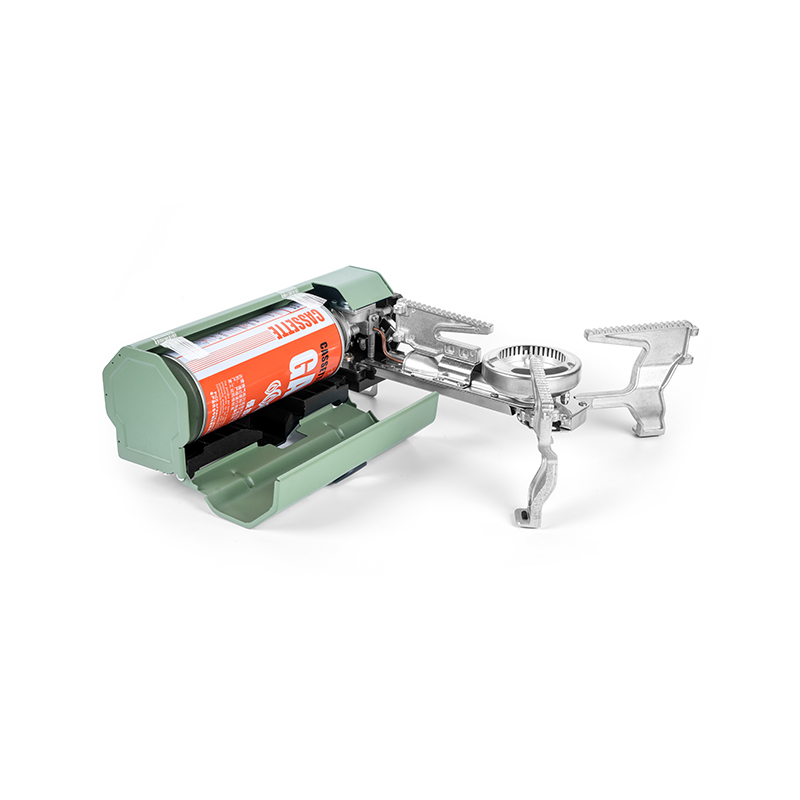
| Folding single burner | Boxy, around 10-15 cm | 200-500 g | Weekend camping, couples | Slightly heavier, more stable |
| Compact multi-burner | Briefcase-like case | 2-5 kg | Group cooking, car camping | Not for long carries |
| Integrated stove system | Nested pot and burner | 300-600 g | Fast boils, windy conditions | Less flexible with other cookware |
Wind is the quiet test of any compact camping stove. A bare burner head loses efficiency quickly when a breeze crosses the flame, so a windscreen, a recessed burner, or a pot that sits close to the flame all help. The best design is not always the one with the highest output; it is the one that keeps a steady flame when conditions are less than perfect.
Pot stability matters just as much. Narrow supports are fine for a small titanium mug, but a full one-liter pot on a narrow burner feels like a balancing act. Look at the width of the support arms, the teeth that grip the pot, and the distance between the burner and the base of the cookware.
Control at low flame is another detail that separates a pleasant stove from a frustrating one. Simmering rice, warming soup, or melting butter all ask for a gentle flame. A valve that jumps from off to full blast is hard to live with. A long, smooth control range is worth more than a flashy ignition system.
Finally, consider the fuel connection. Some stoves sit directly on the canister, which is simple and light. Others use a hose and a separate burner, which lowers the center of gravity and makes it easier to shield the flame. Neither is better in every case, but the choice should match how you cook.
Priorities are weight, packed size, and a reliable boil. A folding single burner with a small pot support is usually enough. If the route is exposed, a windproof design earns its extra grams.
A folding stove with a wider burner head and a hose gives a steadier base and better simmer control. It still packs small, but it feels less like a compromise at dinner time.
When several people need food at once, a compact multi-burner saves time and fuel. These stoves are not meant for long carries, but they pack into a case and set up quickly at a campsite.
 Outdoor 3 Burner Mini Foldable Camping Gas StoveA compact three-burner folding stove with built-in windshield and piezo ignition, suited to campsite cooking for several people.View Product →
Cold canisters lose pressure, so a stove with a preheat tube or a fuel blend suited to low temperatures can make the difference between a hot meal and a lukewarm one. A windscreen and an insulated canister sleeve are simple additions that help.
A compact stove lives a hard life. It gets tossed into packs, dropped on gravel, and heated and cooled over and over. Stainless steel burner heads resist corrosion, brass valves hold up well, and aluminum parts keep the weight down. The details that matter most are often hidden: the thickness of the pot support, the fit of the valve spindle, and the quality of the seals.
We like designs that can be taken apart for cleaning without special tools. A burner that clogs with food or dust is a common reason a stove gets retired early. A simple brush, a soft cloth, and a few minutes after each trip keep the flame even and the ignition reliable.
 Folding Windproof Camping Stove with Extension CatheterA foldable windproof camping stove with extension catheter and enlarged foot pads, offering stable cooking in harsh weather and easier positioning.View Product →
Most compact camping stoves run on butane, isobutane, or propane blends. The canister shape and valve type matter as much as the gas inside. A stove that only accepts one canister style can be limiting in different regions, which is why adapters and hoses are useful for travelers and for brands building a product line for multiple markets.
An adapter should feel solid, thread cleanly, and seal without force. It is a small part, but it sits between the fuel and the flame, so it deserves the same attention as the burner itself. Keep spare seals, check the connection before every trip, and never overtighten a valve.
 Camping Stove Adapter Connector for Gas CanistersA compact aluminum and copper stove adapter for connecting different gas canisters, with an automatic closing, leak-proof design for safer transport and storage.View Product →
Good habits are simple. Check the seal, set the stove on a level surface, keep the canister away from the flame, and let the stove cool before packing. Never cook inside a tent or a closed space. A stove that sputters, smells of gas, or has a yellow, lazy flame should be turned off and checked before it is used again.
After the trip, wipe down the burner, clear the jets if needed, and store the stove dry. A little care at the end of the weekend saves a lot of frustration at the start of the next one.
For outdoor brands and retailers, a compact camping stove is not just a product on a shelf. It is a piece of gear that carries a brand's reputation every time someone lights it. Consistency matters: the same model should fold the same way, light the same way, and hold the same flame across production runs.
That is why we focus on the whole chain: design, tooling, parts, assembly, inspection, and export. As a camping stove manufacturer, we work with OEM and ODM orders, build to drawings or samples, and keep quality checks at each stage. Visitors who want to see how that works in practice are welcome to explore our factory and the processes behind each stove.
A compact camping stove is a small object with a big job. It has to pack down, light reliably, hold a pot steady, and behave well when the weather turns. When those details are right, the stove disappears into the background and the trip takes over. That is the standard we build toward, and it is the reason we still enjoy testing every new design on a real campsite rather than only on a bench.

Copyright © Yongkang Aomijia Industry & Trade Co., Ltd. All Rights Reserved.
Lightweight Camping Gas Stove Cookware Factory

 English
 中文简体
 Español
 Português