Content
A stove that comes apart can look like a step backwards, until you cook on one in a windy valley with a heavy pot of stew. Then the logic becomes obvious: the fuel sits on the ground where it cannot tip over, the burner sits under the pot where it belongs, and a short hose joins the two.
That is the split gas stove in a nutshell. It is the design we build most often for campers who actually cook rather than just boil water, and it is the one buyers ask about once their customers start saying that a canister-top stove feels unstable under a family-sized pot. Below is how the design works, where it genuinely wins, and what to look at before you choose a model.
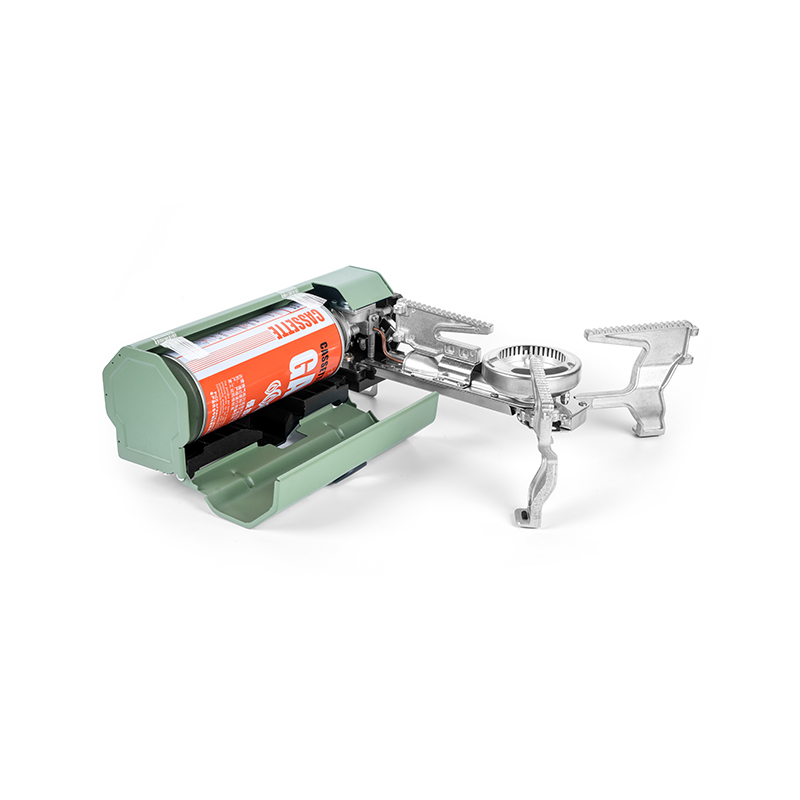
A split gas stove, sometimes called a remote-canister stove, separates the burner head from the fuel container. The burner rides on folding legs or a low frame, a control valve regulates gas flow, and a flexible hose, usually somewhere between 20 cm and 60 cm, runs from the burner to a connector that threads onto or pierces the canister.
The separation is the whole point. Because the canister no longer hangs off the burner, the flame can sit close to the ground, the legs can spread wide, and the pot rests on a support ring designed for its weight instead of being squeezed around a fuel bottle.
Two details separate a well-made split stove from an average one. The first is where the valve sits: at the burner end you get finer control while cooking, while at the canister end you get a lighter, more compact burner assembly. The second is whether the burner carries a preheat tube, a small loop that vaporises liquid fuel on its way to the jet. That loop is what makes an inverted canister workable on a cold morning.
With the fuel on the ground, the heaviest part of the system is no longer balanced on top of a narrow burner column. A wide three- or four-point leg span absorbs the small knocks that happen in a tent vestibule, and a bumped pot is far less likely to take the whole stove with it. Anyone who has watched a full kettle wobble on a screw-on burner understands the difference immediately.
Because the burner is a separate, low-profile unit, a wrap-around windshield can enclose it without trapping heat against the canister. That single change can cut boiling times noticeably in exposed campsites, and it also protects the flame from gusts that would otherwise blow it out at the worst moment.
A split burner with a preheat tube can run from an inverted canister, feeding liquid rather than vapour so the pressure does not collapse as temperatures drop. The same layout usually comes with wider pot supports, which means a two-litre pot or a small frying pan sits flat instead of perching. For group cooking, that is not a luxury; it is the difference between a usable stove and a balancing act.
The comparison below reflects the typical ranges across the split and integrated stoves in our own catalogue, not a single model.
| Feature | Split gas stove | Canister-top stove |
|---|---|---|
| Fuel position | On the ground, beside the burner | Screwed directly under the burner |
| Stability | Low centre of gravity, wide legs | Top-heavy on small base |
| Packed weight | Roughly 180–400 g | Roughly 60–120 g |
| Typical output | 2.5–3.5 kW | 1.5–2.5 kW |
| Pot support width | 15–22 cm | 10–14 cm |
| Wind protection | Full enclosure possible | Limited by canister heat |
| Cold-weather use | Inverted canister with preheat tube | Vapour feed only |
| Best suited to | Group cooking, basecamp, cold trips | Solo fast-and-light trips |
When a buyer asks us to recommend a model, we usually walk through the same short list. It takes five minutes and saves a season of returns.
Every split stove funnels its reputation through one small joint: where the hose meets the canister. A thread that cross-threads once will leak forever after, an O-ring left dry for a winter will crack, and a hose folded sharply at the bottom of a pack will develop a weak spot you cannot see. Most field failures we hear about trace back to these three things rather than to the burner itself.
The other half of the problem is fit. A stove that only accepts one cartridge size limits what a retailer can stock and what a camper can buy on the road. That is why we keep gas valve connector adapters in the range: a small, inexpensive part that decides whether the stove works with the canisters actually sold in that market.
 Gas Tank Adapter Connector for Long TanksA compact adapter that links flat-tank stoves to long gas tanks, with self-closing and leak-proof features for more flexible outdoor fuel use.View Product →
We have been making outdoor gas equipment in Yongkang since 2012, and the split stove is one of the products where in-house tooling genuinely shows. Our team brings more than twenty years of product design and mould-making experience, so burner heads, valve bodies and folding leg assemblies are produced and checked in our own plant rather than assembled from whatever arrives at the loading dock. Automated finishing lines and a precision inspection setup follow the parts through, and each process has its own quality checker. You can read more about our factory and team if you want the detail.
For buyers, that structure matters in practical ways: we hold our own patents and CE documentation, take OEM and ODM orders, and can develop from a drawing or a physical sample. Annual output runs above 300,000 units, which gives smaller importers room to start without being pushed aside, and the plant sits about 45 km from Yiwu port for straightforward export logistics.
Two of our split models show the range of the format. The foldable windproof camping stove with an extension catheter covers general camping and group cooking, with a wide pot ring and a hose long enough to keep the canister clear of the flame.
 Folding Windproof Camping Stove with Extension CatheterA folding camping stove with windproof lotus design, extension catheter, enlarged foot pads and 2800 W output for general camping and group cooking.View Product →
The butane version trims weight for backpackers who still want the burner off the fuel.
 Folding Windproof Butane Stove with Extension CatheterA 264 g folding butane stove with 2800 W output, windproof burner and extension catheter for backpackers who want the burner off the fuel.View Product →
It is heavier than a canister-top stove, typically 180 to 400 g against 60 to 120 g. What you get back is a stove that handles a real pot, stands up to wind, and does not need a separate windshield in many cases. For solo trips the trade is often not worth it; for two people sharing a pack, it usually is.
Yes, with the correct adapter and hose. Long cylinders are common in some markets, and the right connector turns a cartridge-only stove into something a local retailer can actually sell fuel for.
With a preheat tube and an inverted canister, performance holds up far better than vapour-feed designs. Keep the canister off cold ground and accept that no stove makes butane behave well at minus ten.
Inspect it every season and replace it at the first sign of cracking or stiffness. A hose is inexpensive; a leak at the joint is not.
Split stoves are not the lightest thing you can carry, and they are not meant to be. They are the answer for anyone who has decided that dinner should not depend on how steady the pot happens to sit on top of a fuel bottle. If you are weighing up a model for your own range, tell us how your customers cook and where they camp, and we will point you to the configuration that fits rather than the one that looks best on a spec sheet.

Copyright © Yongkang Aomijia Industry & Trade Co., Ltd. All Rights Reserved.
Lightweight Camping Gas Stove Cookware Factory

 English
 中文简体
 Español
 Português