Content
There is a moment every camper recognises. The pot is filled, the valve opens, the igniter clicks, and instead of a clean blue ring of flame you get a sputtering orange flicker that dies the moment a breeze arrives. Nine times out of ten the canister is fine and the pot is fine. The problem is the camping stove head.
We build burner heads for a living, in a workshop where folding stoves, multi-burner frames and torch heads all come off the same lines. What follows is roughly what we tell a friend who asks how to judge a stove head before buying one, and what we tell a buyer who asks how to specify one without surprises later.
The head is the assembly at the top of the fuel line: the jet that meters the gas, the venturi tube that draws air in, the mixing chamber, and the burner cap or plate where the flame actually forms. Everything upstream, from canister to valve to hose, only delivers fuel. The head decides what that fuel becomes.
A well-made head holds a steady blue flame because gas and air are already blended in roughly the right proportion before ignition, and because the ports are sized so the flame sits just above the surface rather than lifting off or dropping back inside. Drill the ports slightly too large and the flame floats away from the cap; slightly too small and it goes soft and yellow, sooting the bottom of the pot and producing far more carbon monoxide than anyone wants inside a vestibule.
Port spacing matters just as much. Holes set too close together let neighbouring flames merge into one ragged sheet of heat. Give them room and you get an even ring that warms the centre of the pot as well as the edges, which is the difference between a simmer and a scorched patch.
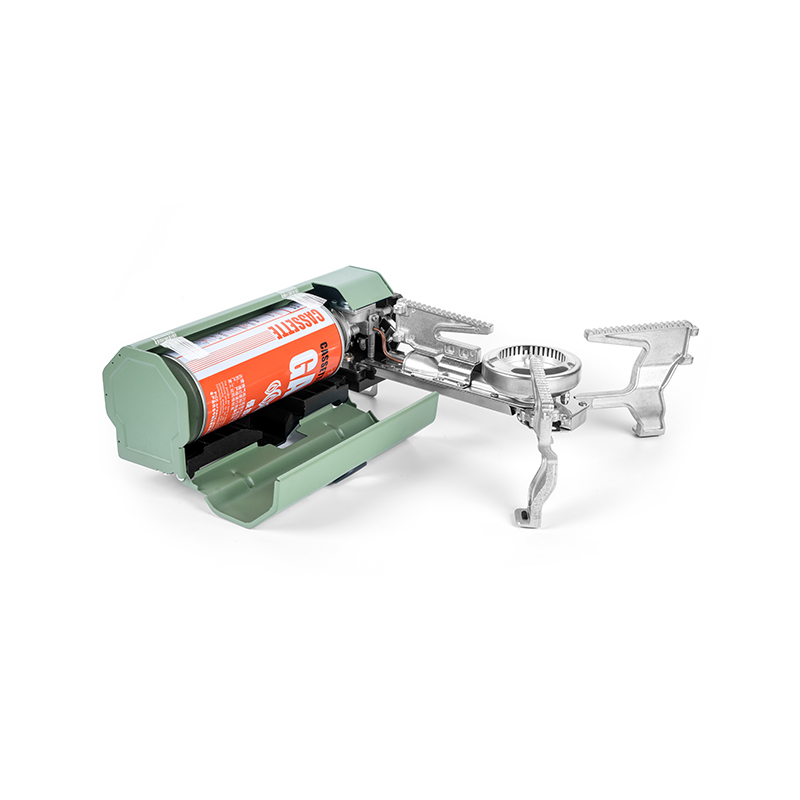
The classic single-ring head is the one most people picture: one circle of ports on a small cap, two or three folding pot arms, and a rated output somewhere in the 2.5 to 3.5 kW range. It boils a litre of water in three or four minutes at sea level, packs into a mug, and asks very little of the user. For solo trips and fast morning coffee it is still hard to beat.
 Outdoor Collapsible Lotus Windproof Camping Stove K-203LFolding 3500W stove with lotus-shaped windscreen, detachable hose and sealing ring, suited to breezy coastal or mountain camping when wind protection matters.View Product →
Shielded heads, sometimes called lotus or petal heads, take the same single-ring idea and sink the ports into a shaped cap with raised walls between them. The walls act as tiny windbreaks, so the flame keeps its shape on an exposed ridge where a flat cap would be blown sideways. In our experience this design is the single most useful upgrade for coastal and mountain cooking, because it buys you performance without adding a separate windshield to your pack.
Multi-core heads go the other way entirely. Three, four, five or seven burner cores share one frame and one gas rail, pushing output into the 7,000 to 10,500 W range so a group can run two pots at once or bring a large Dutch oven up to temperature. The engineering challenge shifts from the port to the manifold: every core needs the same pressure, or one burner will always run rich while another starves.
 High-Power Portable Windproof 7-Core Camping StoveSeven-burner 16,800W stove with multi-level regulator, electronic ignition and three fuel-connection options, aimed at group cooking and large-pot outdoor meals.View Product →
Then there are wide-cap, low-pressure heads built for people who actually cook rather than just boil. Many small ports across a broad cap give a gentle, spread-out flame that holds a simmer without scorching, which is why they turn up on family-style camp stoves.
| Head style | Typical layout | Where it works best | What to check |
|---|---|---|---|
| Single-ring head | One ring of ports, 2.5-3.5 kW | Solo hikes, fast boils, ultralight kits | Port cleanliness, stiffness of pot arms |
| Shielded / lotus head | Petals or walls around recessed ports | Windy ridges, open campsites | Cap fit, even gap around the ring |
| Multi-core head | 3-7 burner cores on one frame | Group cooking, large pots, base camps | Frame rigidity, balanced gas distribution |
| Wide-cap low-pressure head | Large cap, many small ports | Simmering, pancakes, slow stews | Flame spread, lowest stable output |
Brass is still the favourite for burner caps in serious stoves. It machines cleanly, resists corrosion, and holds a drilled port at a stable diameter through years of heating and cooling. Stainless steel is tougher and cheaper to form, but the deburring after drilling has to be done properly, because a burr the size of a grain of sand is enough to send a flame sideways.
Cast iron spreads and stores heat beautifully, which is why it appears on grill plates and heavy-duty caps, though the weight penalty is real. Aluminium keeps things light and affordable, but it is soft, and ports in a soft cap slowly widen with cleaning until the flame no longer looks like it did on day one.
Two things separate a good head from a merely acceptable one, and neither is visible in a product photo. The first is the seal face where the jet screws into the mixing tube; a rough thread or a nicked seat will leak slowly enough that you smell gas before you see a problem. The second is consistency, port to port, unit to unit. If one hole in fifty is oversized, that stove will always have one long lazy tongue of flame.
Butane, isobutane and butane-propane blends all behave differently as the temperature drops, and the head has to be built around that. The jet diameter, the air intake area and even the length of the mixing tube are matched to a fuel's vapour pressure. Run a pure-butane jet on a high-propane mix and the flame will burn fierce and lift; run the reverse and you get a weak, sooty fire that struggles below five degrees.
This is also where connectors earn their keep. A long canister adapter or a valve connector lets one stove run on several canister formats, which matters enormously for travellers buying fuel in unfamiliar countries. Whenever you change the fuel source, check the O-rings as well; nitrile and silicone behave differently against different gas blends, and a perished ring is a fire risk, not an inconvenience.
 High Pressure Single Burner Mini Camping Gas Stove K-202Compact 2,800W high-pressure stove with direct long-canister setup and stable base, suited to fast boiling on backpacking trips where weight and wind matter.View Product →
High-pressure mini heads are the clearest illustration of the trade-off. They deliver a fast, concentrated flame from a very small cap, which is superb for boiling and less lovely for anything you want to cook slowly. Know which of those two jobs you actually do most often.
Judge a head by three things at the stove: colour, shape and sound. A clean blue flame with a faint inner cone is what you want. Yellow tips mean too little air or a dirty port. A flame that roars and lifts off the cap means too much pressure for the port size. Any hissing from the joint below the cap means you should shut the valve and check the connection before going further.
Cold weather is the hardest test, because canister pressure falls with temperature and the head cannot compensate for fuel that refuses to vaporise. Designs with a preheat tube or a generator coil route the flame over the incoming gas line to help, and shielded ports keep a marginal flame alive in wind. If you often cook in the shoulder seasons, it is worth reading up on the key factors when choosing a butane camping stove before you commit to a burner style.
None of this takes more than a few minutes, and it is the reason some stoves still light first time after a decade of weekends.
If you are sourcing stoves rather than using one, the questions change. Ask for the port diameter and its tolerance, not just the rated power. Ask how the cap is deburred and how often drill bits are replaced, because that single detail predicts flame consistency across a whole production run. Ask for a burn test report at low, medium and full valve openings, and for a leak test on every unit rather than a sample.
Then look at the practical side: whether spare caps and O-rings are available, whether the pot arms are rated for the pot sizes your market actually uses, and whether the packaging survives a container journey. Certifications matter as well, and a CE file with real test data behind it is worth more than a logo on a box.
We have been making these parts since 2012, with our own tooling shop, in-house mould making and a quality check at each stage rather than only at the end. If you would like to see how that works in practice, our about page walks through the factory, the design team and the export side of the business.
A camping stove head is a small piece of metal with a few dozen holes in it, and yet it decides whether your morning coffee takes three minutes or fifteen. Whether you are packing for a weekend or specifying a container load, look past the folded frame and the printed power rating. Look at the cap, the ports and the seal, and the rest of the stove will usually take care of itself.

Copyright © Yongkang Aomijia Industry & Trade Co., Ltd. All Rights Reserved.
Lightweight Camping Gas Stove Cookware Factory

 English
 中文简体
 Español
 Português