Content
A movable cooking stove is the quiet workhorse of any outdoor kit. It is the piece of gear you unfold on a windy morning, light with half-frozen fingers, and trust to boil water before the coffee goes cold. Unlike a built-in kitchen range, everything about it has to survive being carried, stacked, dropped and carried again — and still cook a proper meal when it finally lands on the ground.
That balance between portability and performance is where most buying decisions are actually made. After years of building and shipping folding gas stoves, we have noticed the questions buyers ask barely change: will it pack small, will it stand steady, and will it still work after a full season of use? This guide walks through the details that answer those questions.
A stove earns the word movable when one person can pack it, carry it and set it up without a ritual. In practice, that comes down to a handful of details that matter far more than the marketing headline:
A stove that folds to the size of a paperback but wobbles under a two-litre pot is not really movable — it is just small. The useful definition of portability always includes the word "usable".
Most movable cooking stoves on the market today fall into a few recognisable families. They differ in burner count, in how the fuel connects, and in what kind of cooking they are designed to support.
| Format | Burners | Typical use | What to watch for |
|---|---|---|---|
| Single-burner folding stove | 1 | Solo camping, hiking, day trips | Leg stiffness, pan support width |
| Multi-burner stove | 3 to 5 | Family camping, group cooking | Packed bulk, heat spread, weight |
| Integrated stove | 1, with matched pot | Fast boiling, minimal packing | Limited cookware compatibility |
| Split stove with hose | 1 to 2 | Base camp, car camping | Hose length, connection type |
| Torch-style burner | 1 | Searing, fire starting, brazing | Flame adjustment, safety lock |
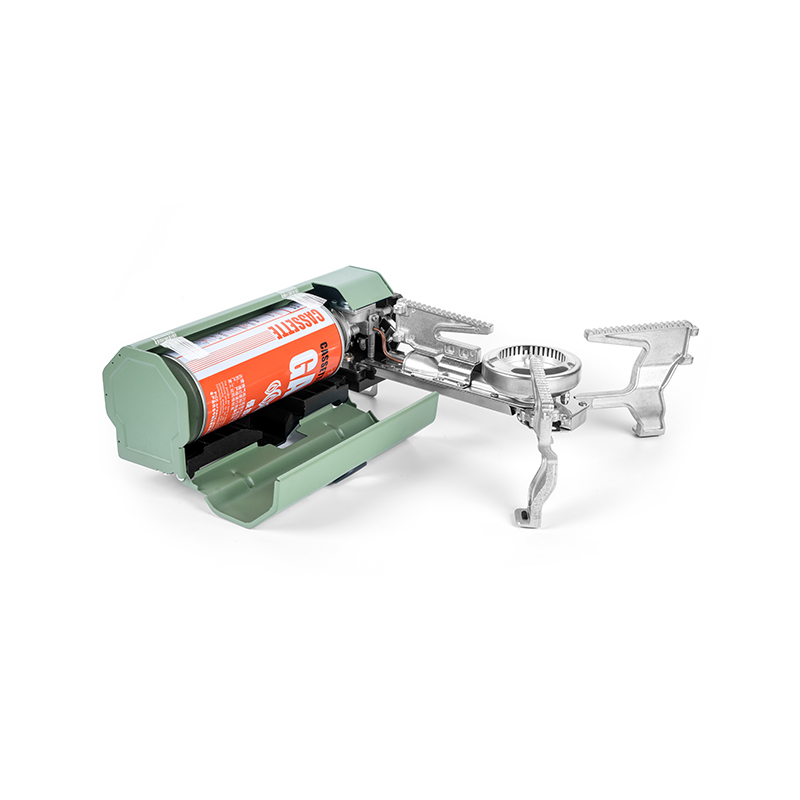
These are the classic answer to "movable". Legs fold flat, the burner head sits low, and the whole unit disappears into a side pocket. Many models add an extension catheter so the canister sits away from the flame, which lowers the centre of gravity and keeps the fuel cooler. Windproof burner heads and a lotus-style flame pattern are common upgrades for exposed campsites.
 K-203K Folding Windproof Camping Stove with Extension CatheterA compact single-burner stove with lotus windproof head, extension catheter and enlarged foot pads; useful when comparing foldable, stable camping cooking options.View Product →
When you compare single-burner models, look past the weight figure. Check the diameter of the pan support, how firmly the legs lock, and whether the valve gives you a usable low flame for simmering rather than only a roaring maximum.
Once more than two people are eating, a single burner becomes a scheduling problem. Three-, four- and five-burner folding stoves solve it by putting several cooking zones on one frame, often with high power output for large pots. They still fold, but the folded package is longer and heavier — a fair trade for cooking rice, a main dish and tea at the same time.
 Outdoor 3-Burner Mini Foldable Camping Gas Stove MA1062A compact three-burner folding stove with built-in windshield, piezo ignition and flame regulator; suited to multi-dish outdoor cooking when pack size and weight are considered.View Product →
The details that separate a good multi-burner from a frustrating one are usually structural: how evenly the frame distributes weight, whether each burner has independent control, and how much heat reaches the valves when all burners run together.
Integrated stoves lock a burner to a matched pot, which makes them efficient and compact but less flexible if you want to use your own pan. Split designs put the burner on a hose, so the canister can sit on the ground and the flame stays where you put it. Neither is better in general — the right choice depends on whether you value speed and packing volume or cooking flexibility.
Movability is only useful if the fuel is easy to find. Butane canisters are widely sold and simple to use, but they lose pressure in cold weather. Propane blends handle lower temperatures better, which matters for anyone cooking in autumn or at altitude. Screw-on valves, bayonet fittings and long flat canisters are not interchangeable, so a stove's connection type quietly defines where it can be sold and used.
This is where a small accessory earns its place in the kit. A gas tank adapter lets one stove accept a different canister format, which turns a single model into a product that suits several regional fuel standards. For travellers and for buyers sourcing for mixed markets, that flexibility is often worth more than a slightly lower unit price.
Two more points deserve a place on any checklist. First, a stove should light predictably — piezo ignition is convenient, but it must still be possible to light the burner with a match when the ignition fails. Second, the valve should have a genuine range: a low simmer for sauces and a strong flame for a large pot of water.
Most accidents with movable stoves are boring rather than dramatic: a tipped pot, a scorched table, a flame that flared because the canister was too warm. A few habits prevent nearly all of them.
Good design supports those habits instead of fighting them. Low burner height, wide-set folding legs, a valve that moves smoothly rather than in sudden jumps, and a pot support with small upturned tabs all make a stove feel safer in real use.
A movable stove lives a harder life than a kitchen appliance. It gets thrown into a boot, stacked under other gear and cleaned in a hurry. Stainless steel burner heads resist rust far better than painted mild steel, brass valves hold their adjustment longer than cheap alternatives, and a properly finished coating stops the frame from scratching through in a single season.
Look at the joints. Folding legs that wobble after a month usually show play at the rivet from day one. Look at the burner ports — evenly punched holes give an even flame, while rough edges create hot spots that warp a pot base over time. These are small manufacturing decisions, but they are the difference between a stove that lasts a summer and one that lasts several.
For distributors, retailers and private-label brands, the questions shift from "which stove do I like" to "which stove will sell and stay sold". That usually means balancing three things: a format that matches local cooking habits, fuel compatibility with what is already on shelves, and documentation that clears customs and retail compliance.
This is the part of the work we know best. Our camping stove manufacturing covers design, mould making, part production, assembly and inspection under one roof, which means a folding stove can be adapted — burner size, leg geometry, valve type, packaging — without rebuilding the supply chain each time. We work from customer drawings or samples, and we keep our own patents and certification documentation in order so that product files are ready when buyers need them.
 Outdoor Camping Stove Adapter P108 for Threaded Extension HoseA lightweight aluminum-alloy and copper adapter with self-locking connection for threaded extension hoses, relevant when specifying stove components for outdoor fuel setups.View Product →
Practically, a sourcing conversation goes more smoothly when the brief includes the market, the fuel standard, the target retail price and the packing format. Those four points shape almost every other decision, from the burner head material to the size of the carton.
None of this takes long, and it is the cheapest way to extend the working life of any portable stove.
A movable cooking stove does not need to be complicated. It needs to fold flat, stand firm, light on the first or second attempt, and give the cook enough control to do more than boil water. Get those basics right and the stove becomes the piece of gear people stop thinking about — which is exactly what good equipment should do.
If you are weighing up formats for a product line, or simply want a second opinion on which configuration suits your market, our team is always happy to talk through the options.

Copyright © Yongkang Aomijia Industry & Trade Co., Ltd. All Rights Reserved.
Lightweight Camping Gas Stove Cookware Factory

 English
 中文简体
 Español
 Português